Birth control methods compared
How to compare them
Every method has two success rates. Perfect use is how well it works when used exactly right every time. Typical use is how well it works in real life, with missed pills and mistakes. is the one to compare.1
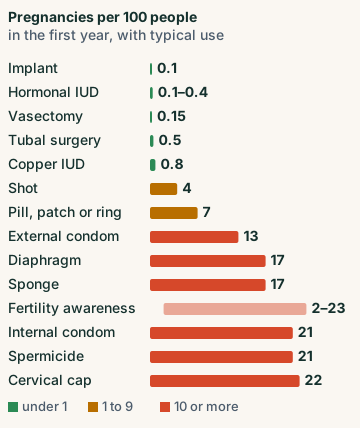
The methods at the top work best because, once they're in place, there is nothing to remember.
The methods
Long-acting, reversible1
- Implant. A thin rod under the skin of the upper arm that releases a for up to 3 years.
- Hormonal IUD. Placed in the uterus by a clinician. Releases a progestin and lasts 3 to 8 years, depending on the device.
- Copper IUD. No hormones. Lasts up to 10 years. It can make periods heavier, especially in the first year.2
Short-acting, hormonal1
- Shot. A progestin injection every 3 months.
- Pill. Taken at the same time every day. Combined pills have estrogen and progestin; progestin-only pills have just progestin.
- Patch. A new one each week for 3 weeks, then a week off.
- Ring. Worn in the vagina for 3 weeks, then a week off.
Barrier and other methods1
- Condoms. External condoms go on the penis; internal condoms go in the vagina. Latex condoms also help prevent HIV and other STIs. "Natural" lambskin condoms may not.
- Diaphragm, cervical cap and sponge. Placed in the vagina before sex, used with spermicide.
- Fertility awareness. Tracking the cycle to avoid sex, or use a barrier, on fertile days.
Permanent1
- Tubal surgery closes or cuts the fallopian tubes. Vasectomy blocks sperm in men; another method is needed for about 12 weeks until a test confirms it worked.
Most methods don't protect against STIs, so condoms are needed for that, alongside any other method.1
More than birth control
Hormonal methods can also treat period problems. Combined methods can make periods lighter and more regular, and the hormonal and the shot may stop bleeding altogether after a year.3 Hormonal methods are also used for painful periods.4
Myth: Birth control ruins your fertility.
It's a very common worry, and an understandable one. A review of 22 studies with nearly 15,000 women found that 83% got pregnant within a year of stopping. The rate was the same for hormonal methods and IUDs, and it didn't matter how long the pill had been used.5
Myth: You need a monthly bleed on the pill to stay healthy.
Many of us assumed the bleed was necessary. The bleed on the pill, patch or ring is a withdrawal bleed, not a true period, and it only happens because the method was designed to mimic a natural cycle. There's no medical reason to have one, and skipping it is usually safe. Talk to your doctor before you start.6
Choosing
There is no single best method. It depends on what matters to you: how effective it is, whether you'd rather not think about it, hormones or no hormones, effects on bleeding, cost and privacy. A doctor, nurse or family planning clinic can help you weigh them.
Recap
- The implant, IUDs and sterilization fail for less than 1 in 100 people a year.
- The shot, pill, patch and ring fail for 4 to 7 in 100 people a year with typical use, mostly because of missed doses.
- Condoms are the only method that also helps prevent STIs.
- Birth control doesn't harm future fertility. Most people get pregnant within a year of stopping.
- Skipping the bleed on the pill, patch or ring is usually safe. Ask a doctor first.
Words to know 6
| implant | A thin rod placed under the skin of the upper arm that releases a progestin for up to 3 years. |
|---|---|
| IUD (intrauterine device) | A small T-shaped device placed in the uterus. It comes in hormonal and copper types. |
| progestin | A lab-made form of progesterone used in many birth control methods. |
| sterilization | A permanent method. Tubal surgery for women or a vasectomy for men. |
| typical use | How well a method works in real life, including missed pills and mistakes. |
| withdrawal bleed | The period-like bleeding during the break week of the pill, patch or ring. It isn't a true period. |
Educational information, not medical advice. Talk to your doctor about your health.