What changes, and in what order
What it is
Puberty is the stretch of years when a child's body becomes an adult's and becomes able to reproduce. The brain sends hormone signals that wake up the ovaries or testicles, and those make the hormones that drive the changes. In girls it usually starts between ages 8 and 13. In boys it starts about two years later, between 9 and 14. It usually takes two to five years.1
Everyone goes through the same changes, in roughly the same order, but at their own speed. Starting earlier or later than friends is common.
The order, for girls
- Breast buds. Usually the first sign, between 8 and 13. Small bumps grow under the nipples and the darker skin around them gets bigger. A little pubic hair may appear too.1
- Body hair and a growth spurt. Usually between 9 and 14. Pubic hair gets thicker and curlier, underarm hair starts, and height can shoot up more than 7.5 cm (3 inches) a year. Skin gets oilier, which can bring acne, and sweat starts to smell.1
- A first period. About two years after breasts start to bud.1,2 The US average is about 12 years and 5 months, and by 15, 98% of girls have had one.2
- The finish. Most girls reach their adult height by about 16, and usually ends between 15 and 17.1
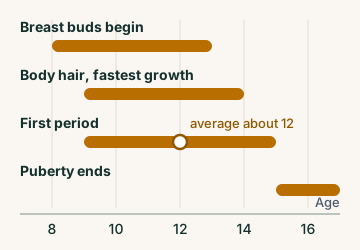
Puberty is starting earlier than it used to. Since the 1970s, the average start has moved almost 3 months earlier every decade, and periods at 8 or 9 are more common.3 The average age of a in the US, though, has barely changed in 30 years.2 So breasts may start growing earlier, and the wait until a first period can be longer.
Feelings change too
Hormone changes and new social pressures can bring mood swings, big emotions and arguments at home. It's also common to have questions about identity, confidence and sexuality.1 These are part of , not a sign that something is wrong. Strong anxiety, sadness or anger that doesn't pass is worth talking to a doctor about.1
A first visit with an OB-GYN
ACOG, the US group of , recommends a first visit with an OB-GYN between ages 13 and 15. It may be just a talk: a chance to ask questions about the body, growing up and sex, and to find out what future visits will be like.4 There may be no pelvic exam at all, and cervical cancer screening doesn't start until 21. Vaccines such as the may be given.4 Feeling nervous is normal, and it helps to tell the doctor.4
When to see a doctor
- signs of start before age 8
- there are no by age 13
- there is no period by 15, or within 3 years of breasts starting to grow
- there is a lot of acne that doesn't go away, or pain with
Recap
- Puberty in girls usually starts between 8 and 13, and in boys between 9 and 14. It lasts two to five years.
- Breast buds usually come first, then pubic and underarm hair and a growth spurt.
- A first period usually comes about two years after breasts start to grow, at about 12 on average.
- See a doctor if signs start before 8, there are no breast buds by 13, or there is no period by 15 or within 3 years of breast buds.
- A first visit with an OB-GYN is recommended between 13 and 15. It may be just a talk.
Words to know 6
| breast buds | Small, sometimes tender bumps under the nipples. Usually the first sign of puberty in girls. |
|---|---|
| first period | The first time a person menstruates. Doctors call it menarche. |
| growth spurt | A period of very fast growth in height during puberty. |
| HPV vaccine | A vaccine that protects against the virus that causes most cervical cancer. It is given to preteens and teens. |
| OB-GYN | A doctor who specializes in reproductive health, pregnancy and birth. |
| puberty | The years when a child's body matures into an adult's and becomes able to reproduce. |
Educational information, not medical advice. Talk to your doctor about your health.