The organs inside
What they are
The organs that make periods, pregnancy and birth possible sit inside the pelvis, between the bladder in front and the rectum behind. From the outside in, they are the vagina, the , the , the two and the two ovaries.
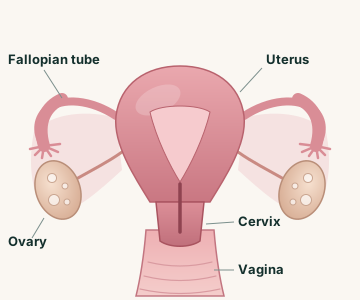
The parts
- Vagina. A muscular canal from the vaginal opening to the , about 7 to 10 cm (3 to 4 inches) deep. Its walls have folds that let it stretch a lot, during sex and for a baby during birth, and then return to size.1
- Cervix. The narrow lower end of the . A small opening through it lets sperm in and period blood out, and it widens during birth.2
- Uterus. A hollow organ about the size of a fist, roughly 7.5 cm (3 inches) long when not pregnant. In pregnancy it can grow to the size of a watermelon.3 Its inner lining, the endometrium, thickens each cycle and is shed in a period. Its thick middle layer of muscle, the myometrium, contracts to cause cramps and to push a baby out in labor.3
- Fallopian tubes. Two tubes about 10 to 13 cm (4 to 5 inches) long that leave the top of the uterus and end near each , without being attached to it. Finger-like fringes at the end sweep a released egg inside, and tiny hairs in the lining move it toward the uterus. Sperm usually meets the egg here.4
- Ovaries. Two oval organs, one on each side of the uterus, on average about 4 cm (1.5 inches) long. They make the hormones estrogen and progesterone and hold the eggs, each one in a small sac called a follicle.5
Most uteruses tip forward toward the bladder. In about 20 to 25% of people it tips back toward the spine instead, and that is a normal variation.3
Eggs: all there before birth
A female fetus has about 6 million eggs. By birth about 1 million are left, and by puberty about 300,000. The number keeps falling with age and with every cycle, and no new eggs are made.2 Usually one egg is released each cycle, until menopause.5 The fertility section explains what this means for fertility over time.
The pelvic floor
The pelvic floor is a bowl-shaped sling of muscles at the bottom of the pelvis. It holds up the bladder, bowel and , and the urethra, vagina and anus all pass through it.6 It:6
- controls when you pee, poop and pass gas, and stops leaks when you cough, laugh or sneeze
- works with the stomach muscles and diaphragm to support posture
- contracts during sex and orgasm
- supports a growing baby in pregnancy and helps during a vaginal birth
Pregnancy, childbirth, heavy lifting, a long-term cough and ageing can weaken these muscles. Weak muscles can lead to leaking pee, poop or gas, or to prolapse, when an organ drops down. Muscles that are too tight can cause pelvic pain, constipation, trouble peeing and painful sex.6 Both are common, and both can be treated: physical therapists who specialize in the teach exercises, including Kegels, that help these muscles work properly again.6
How it compares in boys and men
The ovaries and the testicles are the matching organs. The difference is timing. The ovaries hold every egg before birth and only lose them from there.2 The testicles start making sperm at puberty and can keep making it for the rest of life.7,8 They hang outside the body because sperm is made best at a temperature about 3°C (5°F) below body temperature.8
Men have a too. It holds up the bladder and bowel, supports the prostate, and helps with erections and ejaculation.6
When to see a doctor
Talk to a healthcare provider if you:6
- leak pee, poop or gas
- have pain in the pelvis that doesn't go away
- find it hard to pee or poop
- have pain during sex
If you could be pregnant and have bleeding or pain in the pelvis, tell a doctor. More than 90% of ectopic pregnancies, ones that grow outside the , are in a , and as they grow they can make the tube burst.9
Get care now: go to an emergency room for sudden, severe pain in the belly or pelvis, shoulder pain, or weakness, dizziness or fainting in early pregnancy.9
Recap
- The vagina leads to the cervix, the lower end of the uterus. Fallopian tubes run from the top of the uterus to near each ovary.
- The uterus has a lining that is shed in a period and a muscle layer that contracts in cramps and labor.
- The ovaries hold all the eggs a person will have. About a million are there at birth.
- The pelvic floor muscles hold the organs up and control pee and poop. They can be weakened, and they can be trained.
Words to know 10
| cervix | The narrow lower end of the uterus. It opens into the vagina. |
|---|---|
| ectopic pregnancy | A pregnancy that implants outside the uterus, most often in a fallopian tube. It needs urgent care. |
| endometrium | The lining of the uterus. It thickens each cycle and is shed in a period. |
| fallopian tube | A narrow tube that carries an egg from near an ovary to the uterus. |
| follicle | A small sac in an ovary where an egg develops. |
| myometrium | The muscle layer of the uterus. It contracts during cramps and labor. |
| ovary | One of two organs that hold the eggs and make estrogen and progesterone. |
| pelvic floor | A sling of muscles at the bottom of the pelvis that holds up the bladder, bowel and uterus. |
| prolapse | When a pelvic organ drops down because its support has weakened. |
| uterus | The organ where a pregnancy grows. Also called the womb. |
Educational information, not medical advice. Talk to your doctor about your health.