How the cycle works
What it is
The menstrual cycle is the monthly pattern the body follows to get ready for a possible pregnancy. Hormones, which are chemical messengers in the body, rise and fall to run it.
A period () is only the start. It is the shedding of the lining of the . A cycle is counted from the first day of one period to the first day of the next.
In each cycle, the body does three main things:
- It builds up the lining of the uterus.
- It releases an egg from an .
- If there's no pregnancy, it sheds the lining. That is the next period.
Where it happens
Four parts of the body do most of the work. The ovaries hold the eggs. Each connects to the through a fallopian tube. The uterus is where a pregnancy grows, and its lining is what is shed in a period. The cervix is the narrow lower end of the uterus, and it leads to the vagina.
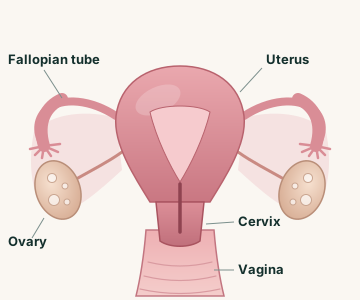
Inside each ovary are thousands of tiny sacs called . Each holds an egg. In each cycle, a group of them starts to grow, and usually one gets ahead of the rest.
Drawings show these organs spread apart so each one is easy to see. In the body they sit close together in the pelvis. The uterus lies between the bladder and the rectum, and it usually tips forward toward the bladder.1
The phases of the cycle
Cycle length, and how long each phase lasts, is different from body to body. Regular cycles can be anywhere from 21 to 35 days, and 28 days is the average.2 The circle below is only an example, using a 28-day cycle.

The cycle is split at because that is where the switch roles: estrogen leads the first half, progesterone the second.3 The phases are named for what happens in the :
- Follicular phase (from day 1 until ovulation). starts on the first day of this phase and usually lasts 3 to 7 days.3 In this phase a group of starts to grow. After the period, estrogen rises and the lining of the thickens. One follicle matures its egg.
- Ovulation. A sudden rise in a hormone called LH tells an ovary to release the egg. In a 28-day cycle this happens around day 14. In shorter or longer cycles, it moves.3 The release itself takes only a few seconds, and the egg survives about 12 to 24 hours.4 Sperm can live in the uterus for three to five days, so sex can lead to a pregnancy from about five days before ovulation to one day after. That span is called the fertile window.4
- Luteal phase (from ovulation until the next period). Progesterone rises and matures the lining: glands in it start to store energy, and its blood supply grows, ready for a fertilized egg to attach.5 If the egg isn't fertilized, estrogen and progesterone drop, the lining sheds, and a new period starts. This phase usually lasts about 12 to 14 days.6 If the egg is fertilized, a different signal keeps progesterone high and the period doesn't start. The next lesson explains how. The phase is named for the corpus luteum, which also comes up there.
The next lesson explains the hormones behind each phase, step by step.
Recap
- A cycle is counted from day 1 of one period to day 1 of the next. Regular cycles can last anywhere from 21 to 35 days.
- The follicular phase runs from day 1 to ovulation. Menstruation is the start of it.
- Ovulation releases one egg, which survives about 12 to 24 hours. Pregnancy is possible from about five days before ovulation to one day after.
- The luteal phase runs from ovulation to the next period and usually lasts about 12 to 14 days. Progesterone matures the lining so it could support a pregnancy.
- The organs sit close together in the pelvis, with the uterus between the bladder and the rectum.
Words to know 12
| atresia | When a follicle stops growing and breaks down instead of releasing its egg. |
|---|---|
| cervix | The narrow opening at the bottom of the uterus that leads to the vagina. |
| fallopian tube | A narrow tube that carries an egg from an ovary to the uterus. |
| fertile window | The days in each cycle when sex can lead to a pregnancy. |
| follicle | A small sac in an ovary where an egg develops. |
| follicular phase | The first part of the cycle. It runs from day 1 to ovulation, while follicles grow and the uterine lining thickens. |
| hormone | A chemical messenger in the body. |
| luteal phase | The second part of the cycle. It runs from ovulation until the next period. |
| menstruation | A period. The shedding of the lining of the uterus. |
| ovary | One of two organs that hold the eggs and make estrogen and progesterone. |
| ovulation | When an ovary releases an egg. |
| uterus | The organ where a pregnancy grows. Its lining is what is shed in a period. |
Educational information, not medical advice. Talk to your doctor about your health.